The PANOPELS Model: A Structured Decision-Making Framework Explained

 FRAMEWORK

Vijayagopal’s PANOPELS Model (VPM): A Structured Decision-Making Framework Explained

A Structured Decision Intelligence Framework

Decision Intelligence as Architecture

Decision-making today requires more than intuition or isolated analysis. It demands a disciplined approach that integrates analytical rigour, human judgement, organizational learning, and strategic alignment as a structured decision-making framework for complex organizational decisions.

Most approaches address parts of this process.

PANOPELS Model is not a tool; it is a complete decision architecture.

Why an Integrated Framework

Popular tools provide partial insights, but they do not cover the full decision lifecycle. The absence of integration leads to inconsistency, weak ownership, and suboptimal outcomes.

The framework addresses this gap by providing a unified decision structure that connects analysis, evaluation, learning, and strategy, thereby functioning as a comprehensive decision intelligence framework

A Structured Decision Intelligence Framework

PANOPELS Model: Integrated Structure

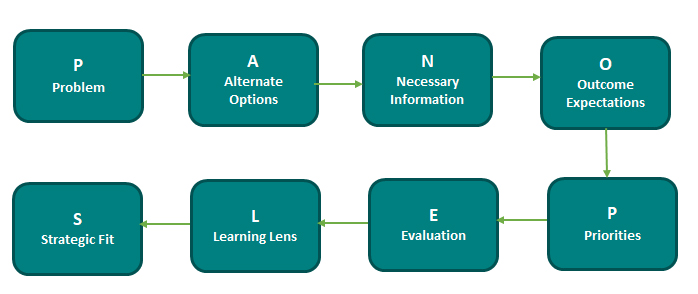
Each step of P.A.N.O.P.E.L.S. represents a distinct decision question:

P Problem: Defines the real decision issue, separating root causes from symptoms.
A Alternatives: Develops multiple, distinct decision options.
N Necessary Information: Identifies only decision-critical data.
O Outcome Expectations: Maps expected gains, risks, and consequences.
P Priorities: Establishes and weights what matters most.
E Evaluation: Compares alternatives using structured, weighted assessment.
L Learning Lens: Ensures that past decisions actively inform current choices and reduces the risk of repeated errors.
S Strategic Fit: Validates alignment with long-term direction.

The Core Innovation: Learning Lens

Most decision intelligence frameworks are forward-looking. PANOPELS Model is bi-directional. It evaluates future outcomes, while systematically integrating past learning

This helps prevent:

  • Repetition of errors
  • Over-reliance on fresh analysis alone

Visual representation of PANOPELS Model (VPM)

Decision Pathways in PANOPELS Model

The framework recognises that decisions do not always follow linear logic.

Two pathways emerge:

1.Convergence Pathway

When evaluation, learning, and strategy align naturally

2.Structured Override Pathway

When experience or strategic insight justifies deviation from the numerical outcomes

How PANOPELS Model Works in Practice

  • Sequential but not rigid
  • Structured yet flexible
  • Allows feedback and refinement
  • Scalable across decision levels
  • Applicable across sectors
  • Analytical yet judgement-sensitive

Integration with Existing Tools

PANOPELS Model does not replace analytical tools. It integrates them into a coherent decision process, ensuring their outputs contribute meaningfully to final decisions.

The framework does not replace judgement; it structures it.

Positioning Insight

The framework does not make decisions predictable.

It makes them structured, transparent, accountable and defensible.

Contact

UG-99, Ulloor Gardens,

Thiruvananthapuram - 695011, Kerala, India

Email: inform@panopelsmodel.com

Phone: +91 9567695559

Connect