Vijayagopal’s PANOPELS Model (VPM): A Structured Decision-Making Framework Explained
Decision-making today requires more than intuition or isolated analysis. It demands a disciplined approach that integrates analytical rigour, human judgement, organizational learning, and strategic alignment as a structured decision-making framework for complex organizational decisions.
Most approaches address parts of this process.
PANOPELS Model is not a tool; it is a complete decision architecture.
Popular tools provide partial insights, but they do not cover the full decision lifecycle. The absence of integration leads to inconsistency, weak ownership, and suboptimal outcomes.
The framework addresses this gap by providing a unified decision structure that connects analysis, evaluation, learning, and strategy, thereby functioning as a comprehensive decision intelligence framework
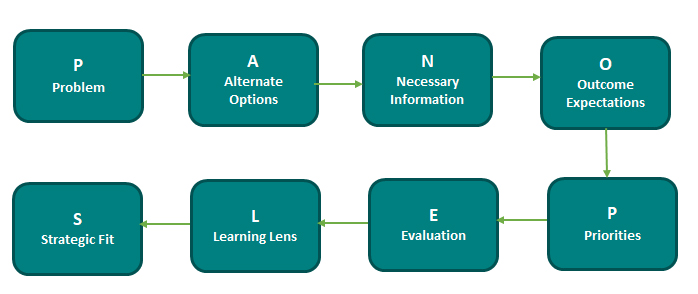
Each step of P.A.N.O.P.E.L.S. represents a distinct decision question:
Most decision intelligence frameworks are forward-looking. PANOPELS Model is bi-directional. It evaluates future outcomes, while systematically integrating past learning
This helps prevent:
The framework recognises that decisions do not always follow linear logic.
Two pathways emerge:
1.Convergence Pathway
When evaluation, learning, and strategy align naturally
2.Structured Override Pathway
When experience or strategic insight justifies deviation from the numerical outcomes
Integration with Existing Tools
PANOPELS Model does not replace analytical tools. It integrates them into a coherent decision process, ensuring their outputs contribute meaningfully to final decisions.
The framework does not replace judgement; it structures it.
Positioning Insight
The framework does not make decisions predictable.
It makes them structured, transparent, accountable and defensible.
UG-99, Ulloor Gardens,
Thiruvananthapuram - 695011, Kerala, India
Email: inform@panopelsmodel.com
Phone: +91 9567695559