APPLICATIONS & INSIGHTS

Real-World Applications of a Structured Decision-Making Framework (Vijayagopal’s PANOPELS Model)

Sectoral Applications

Corporate & Business Decisions

Strategic investments, cost optimization, expansion decisions etc.

Healthcare Institutions

Clinical investments, cost management, operational decisions etc.

Public Policy & Governance

Policy evaluation, regulatory decisions, institutional frameworks etc.

Academic Use

Management education, decision science teaching, research etc.

A Structured Decision Intelligence Framework

Applications of PANOPELS Model in Real-World Decisions

The framework is designed for real-world decision environments where complexity, uncertainty, and accountability intersect.

The following applications are drawn from anonymised institutional contexts across healthcare, information technology, and trade. They illustrate how a structured decision architecture improves clarity, evaluation, and strategic alignment.

Professional Application Note

The framework has been applied in real-world institutional contexts across sectors including healthcare, information technology, and trade.

Due to the strategic and confidential nature of these decision environments, specific institutional details and endorsements are not publicly disclosed.

The applications presented are anonymised representations intended to illustrate the structure and effectiveness of the framework.

Professional Application Note

Featured Decision Applications

Case 1: Strategic Funding Decision (Healthcare)

Balancing growth, control, and financial sustainability

Context

A multi-specialty hospital planning large-scale expansion needed to determine the most appropriate funding structure while balancing financial sustainability, ownership considerations, and long-term strategic flexibility.

A Structured Decision Intelligence Framework

Decision Challenge

The core issue was not whether to expand, but how to fund expansion without:

  • Excessive financial risk
  • Loss of strategic control
  • Long-term governance stress

How PANOPELS Model Helped

  • Structured comparison of multiple funding options
  • Balanced cost, risk, control, and flexibility
  • Integrated financial evaluation with strategic intent

Outcome Insight

A hybrid funding model (equity + debt) emerged as the most balanced solution, aligning financial discipline with long-term growth objectives.

Key Takeaway

Optimal decisions often lie in balanced structures, not extreme choices.

Featured Decision Applications

Case 2: Strategic Cost Management (Healthcare)

Balancing cost efficiency with clinical quality and long-term sustainability

Context

A hospital facing rising operating costs needed to restore margins without compromising clinical quality or long-term competitiveness.

Strategic Cost Management (Healthcare)

Decision Challenge

Traditional approaches presented trade-offs:

  • Cost-cutting vs quality
  • Technology vs affordability
  • Short-term relief vs long-term sustainability

How PANOPELS Model Helped

  • Evaluated multiple strategic pathways beyond cost-cutting
  • Incorporated operational, financial, and clinical dimensions
  • Applied the Learning Lens to avoid past single-lever failures

Outcome Insight

A multi-lever strategy combining efficiency improvement, revenue optimization, and selective technology adoption was adopted.

Key Takeaway

Complex challenges require integrated solutions—not isolated interventions.

Featured Decision Applications

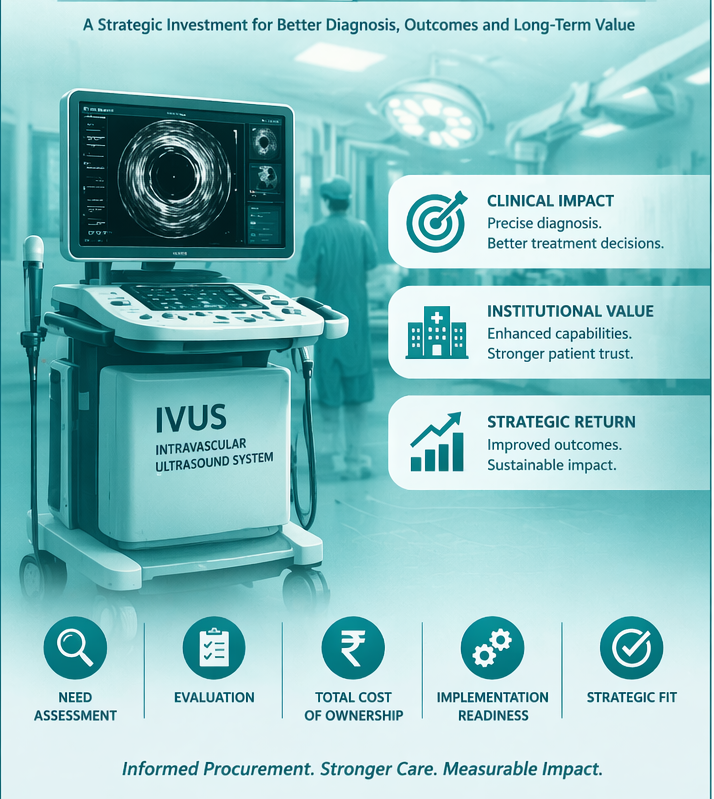
Case 3: IVUS Equipment Procurement (Healthcare)

Aligning technology investment with reliability, risk control, and strategic intent

Context

A tertiary hospital needed to upgrade its imaging capability in a competitive cardiology environment after a previous investment underperformed.

IVUS Equipment Procurement (Healthcare)

Decision Challenge

The hospital had to balance:

  • Clinical excellence
  • Financial exposure
  • Operational reliability
  • Technological flexibility

How PANOPELS Model Helped

  • Compared ownership, leasing, and partnership models
  • Evaluated both financial and operational dimensions
  • Applied the Learning Lens to identify hidden execution risks

Outcome Insight

Despite a higher-scoring option, a lease model with service guarantees was selected through a structured override to ensure reliability and strategic alignment.

Key Takeaway

The best decision is not always the highest-scoring one. It is the one that withstands experience and strategic scrutiny.

Featured Decision Applications

Case 4: Product Strategy (IT Startup)

Balancing innovation ambition with execution capability and market positioning

Context

An early-stage IT startup needed to allocate limited resources between developing new AI features and scaling its core product.

A Structured Decision Intelligence Framework

Decision Challenge

The team had to balance:

  • Innovation vs stability
  • Speed vs sustainability
  • Market positioning vs execution capability

How PANOPELS Model Helped

  • Disciplined evaluation of growth pathways
  • Balanced innovation ambition with operational realities
  • Ensured alignment with long-term market positioning

Outcome Insight

A combined strategy involving AI partnership alongside core product scaling was adopted, ensuring both innovation and stability.

Key Takeaway

Growth strategies succeed when innovation and execution are aligned, not opposed.

Featured Decision Applications

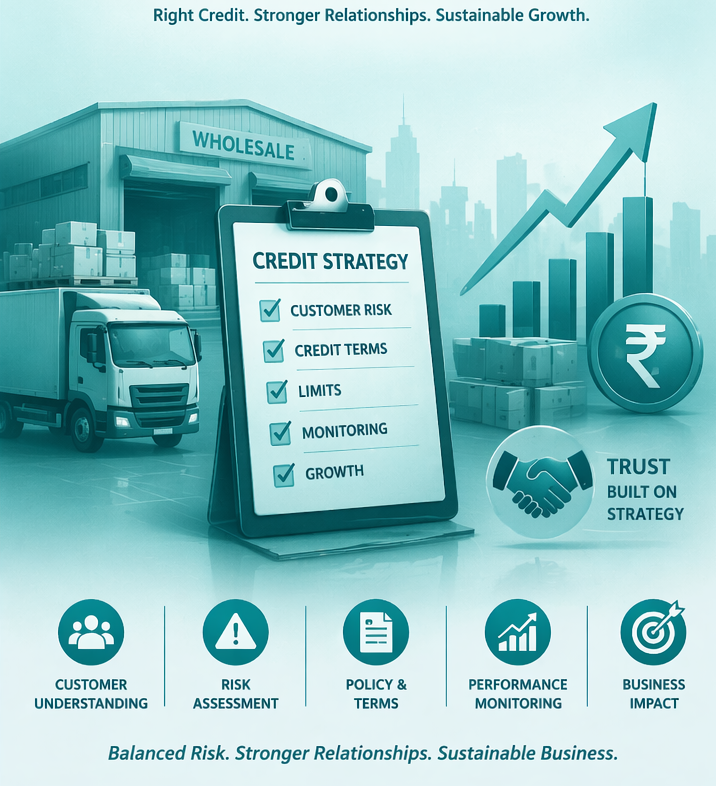
Case 5: Credit Strategy (Wholesale Trade)

Aligning growth opportunities with risk discipline and timing readiness

Context

A wholesale trading firm needed to revise its credit policy in response to market pressures and risk considerations.

A Structured Decision Intelligence Framework

Decision Challenge

The firm had to balance:

  • Growth vs risk exposure
  • Immediate expansion vs timing discipline
  • Market opportunity vs financial prudence

How PANOPELS Model Helped

  • Evaluated aggressive vs conservative credit approaches
  • Applied Strategic Fit to assess timing and readiness
  • Prevented premature risk-taking

Outcome Insight

The decision favoured continuing current policy with phased preparation, aligning timing with organizational readiness.

Key Takeaway

Timing is a strategic variable; not all opportunities must be pursued immediately.

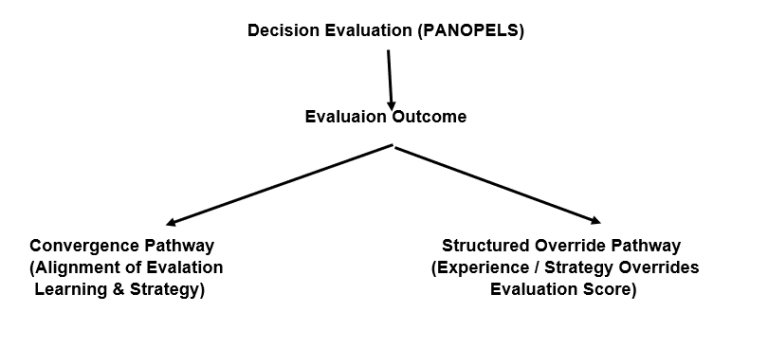
Understanding Decision Pathways in PANOPELS Model

These applications illustrate two distinct pathways within the framework:

Convergence Pathway → When evaluation, learning, and strategy align
 Structured Override Pathway→ When experience or strategy justifies
deviation from numerical outcomes

Decision Pathways in PANOPELS Model (VPM): Convergence and Structured Override

Decision Evaluation (PANOPELS)
Evaluation Outcome
Convergence Pathway
Alignment of Evaluation, Learning & Strategy
Decision Finalised
(Aligned Outcome)
Structured Override Pathway
Experience / Strategy Overrides Evaluation Score
Decision Finalised
(Justified Override)

These pathways illustrate how the framework combines structured evaluation with experiential and strategic judgement.

This dual-path approach ensures that decisions remain:

  • Analytical
  • Experience-informed
  • Strategically aligned

Key Insights from Applications

The framework demonstrates that:

  • High-quality decisions are not accidental, they are the outcome of structured thinking, disciplined evaluation, and strategic alignment.
  • Evaluation supports judgement, it does not replace it
  • Learning from past decisions is critical to future success
  • Strategic alignment must be explicitly validated, not assumed
  • Decision quality is not driven by information alone, but by the structure through which information, judgement, experience, and strategy are integrated.
Vijayagopal’s PANOPELS Model (VPM)
Future Impact Measurement

Future Impact Measurement

PANOPELS Model is built with a strong Learning Lens that turns every decision into an opportunity for continuous improvement. The case applications presented here demonstrate the immediate value of structured decision-making: clearer choices, better alignment, and disciplined accountability.

While full quantified impact emerges after implementation, the framework’s engagements can include optional structured outcome tracking from the very beginning. As decisions mature, anonymised impact insights, including financial results and realised vs. expected outcomes, may be shared where confidentiality permits. Organizations that wish to incorporate formal impact measurement as part of their PANOPELS Model programme are invited to discuss this during the design stage.

Professional Note

Detailed frameworks, templates, and full application structures are part of structured programmes and are shared in professional engagements.

Published Work

PANOPELS Model  has been presented in published form, outlining its conceptual foundations, structured architecture, and relevance to contemporary decision environments. 

Featured Article

“Vijayagopal’s PANOPELS Model (VPM):

An Eight-Step Architecture for Disciplined Decision-Making”

Published in Executive Knowledge Lines, January 2026

Short Summary

This article presents PANOPELS Model as a structured response to the increasing complexity of decision-making in organizational and public contexts. It highlights the need for an integrated decision architecture that ensures completeness, coherence, and strategic alignment.

The model is articulated through eight interconnected steps, each addressing a critical decision question—from problem definition to final strategic validation—while integrating learning from past decisions and emphasising disciplined judgement.

This publication presents the conceptual foundation of framework. Detailed applications and extended methodologies are developed through structured professional engagements

Read Full Article (PDF)

Contact

UG-99, Ulloor Gardens,

Thiruvananthapuram - 695011, Kerala, India

Email: inform@panopelsmodel.com

Phone: +91 9567695559

Connect